
On this Page
Tool Consolidation
Case Study
5 min read
Scaling Application Security at Travelport
Centralizing Security Visibility for 6,000 Repos.
Industry
Travel Tech
Repositories
6,000
Developers
500
“I would tell any peer that Boost is a great tool. It's an all-in-one style solution and it is a good buy."
.svg)
001 / The Problem
Fragmented Tooling & Limited Repository Visibility
For the AppSec team at Travelport, a lack of environmental data created a massive obstacle to scaling security efforts. Jillian Rodriguez oversaw a footprint of 6,000 repositories and 500 developers as Travelport's AppSec Team Lead, managing a lean team of two other security engineers. When she arrived at Travelport, Rodriguez found a fragmented, legacy stack of AppSec tools: Fortify On Demand and Sonatype Nexus, both of which required constant manual intervention.
Legacy tools created scaling pain in two ways. First, some legacy infrastructure was on-prem, forcing Rodriguez into a dual role as system administrator.
“I had to manage that on-prem solution. Any time there was a problem with the VM certificates, scanning would go down. We were maintaining infrastructure where we should have been addressing risk.”
Second, the team lacked a comprehensive view of their own attack surface. Without an automated way to pull repository data, "shadow repos" and archived projects remained invisible. "I had no visibility. That's the easiest way to say it," Rodriguez explained.
When these legacy tools identified vulnerabilities, informing developers and checking on their work was completely manual. Findings were trapped in multiple UIs, requiring AppSec team members to send individual emails to developers to request fixes. This created a permanent bottleneck that led to increasing security debt across the organization. Something needed to change.
002 / The Boost solution
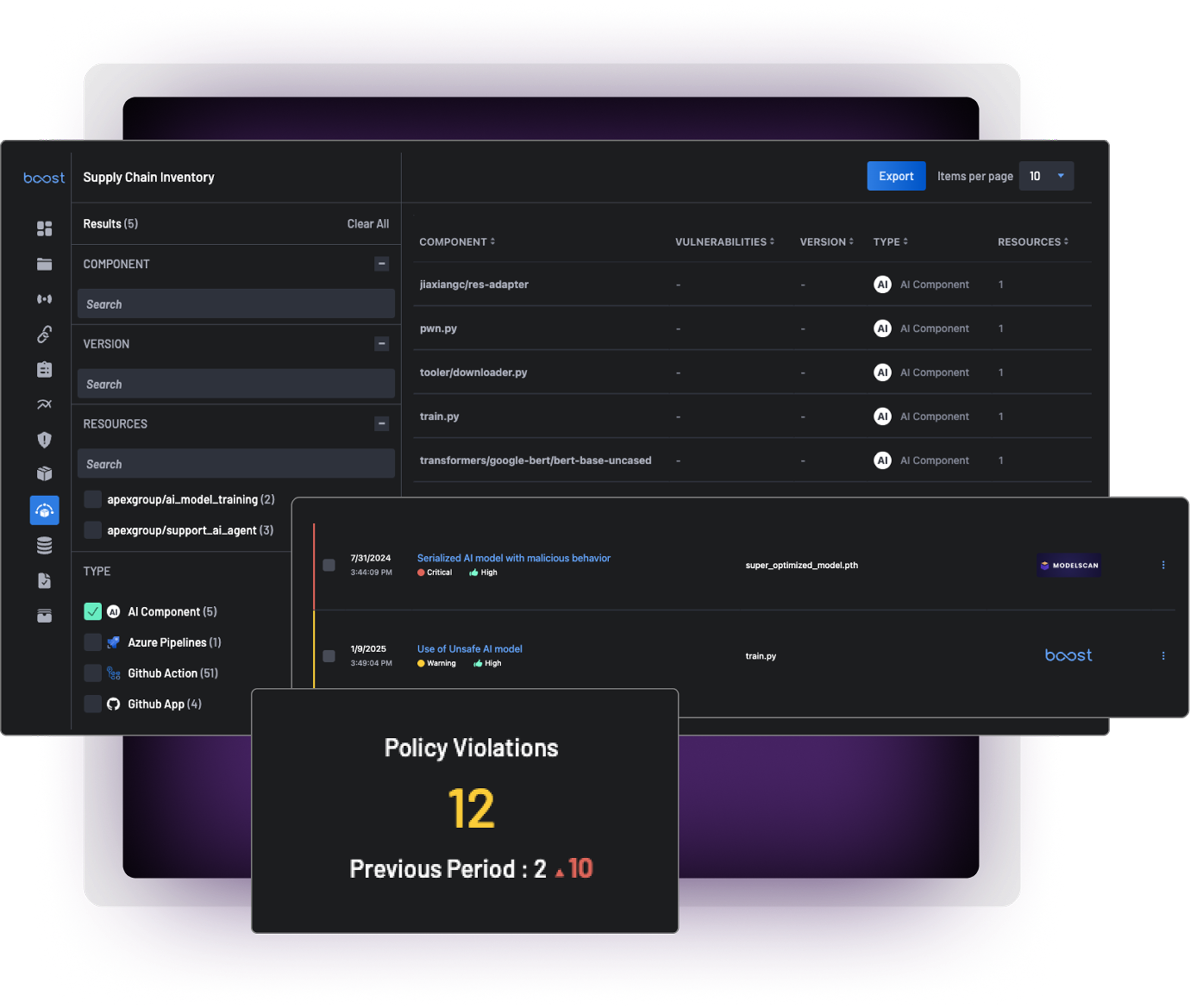
Tool Consolidation + Automation = Value
In the summer of 2024, Rodriguez began evaluating a shift to a cloud-native, unified platform. Her objective was to consolidate the functions of her existing legacy scanners into a single dashboard. While the team reviewed major incumbents including Snyk, the final decision was driven by a comparison of functionality versus cost.
"From what I could see, functionality-wise it was 1:1 between Boost and Snyk," she said, but noted that Boost's price point was significantly better.
“If I can cut costs in scanners, I'd rather do that than cut people. The best thing for us was finding a way to consolidate that actually saved us money.”
Boost offered three major Security Boosts that Travelport knew could accelerate and scale their AppSec program:
003 / How it works
Deployment Strategy & Engineering Onboarding
Boost's rollout happened fast, with Rodriguez and her team implementing a fully change-managed migration of their 6,000-repository footprint in just under 90 days, including developer training.
This accelerated process was made possible by Boost's capability to hook directly into GitHub, instantly mapping Travelport's true scanning footprint. "That's the best part of Boost," Rodriguez said. "Actually seeing what your scanning footprint should be, knowing what's active and what's archived instead of relying on guesswork."
Deployment success also hinged on Rodriguez's communication strategy, initiated months before the first scan. Bypassing the common Boost "silent mode" deployment where developers are brought in at a later stage, Rodriguez saw her devs as partners and opted for radical transparency within the engineering organization. She attended executive-level calls months in advance to set expectations for the tool consolidation, and held training sessions in advance of the January 2025 launch.
"It just works better for us to be hooked in with engineering, so we can let them know in advance what changes are coming," she explained. To drive adoption among 500 developers, she augmented live developer training sessions with video-based training modules, which Rodriguez found more effective than static documentation for accelerating onboarding.
90 days!
Fully change-managed migration of 6,000 repositories, including developer training across 500 engineers.
004 / The result
Defensible Security Spending & Automated Visibility
One year after migrating to Boost, the AppSec program at Travelport has moved from a reactive maintenance model to an automated oversight model. Rodriguez has been able to centralize AppSec findings and see risks in a single tool that automatically detects new repositories, giving her team of three a level of visibility that was previously impossible.

Visibility Gains
Rodriguez estimates a minimum 80% increase in visibility of the application surface across the enterprise.

Lower Developer Friction
By automating security checks and removing manual pipeline management, Rodriguez streamlined the developer experience.

Budget Defensibility
The consolidation of Travelport's AppSec stack gave Rodriguez a strong position in budget negotiations.

Automated Oversight
A single tool that automatically detects new repositories, replacing reactive maintenance.
Stay ahead of the threat.
Get the latest security research, pipeline attack analysis, and Boost product updates delivered to your inbox.