Are your devs’ coding agents adding risk?
Would your EDR even notice if those agents brought malware in?
What could an attacker reach from one developer's laptop with agentic tools installed?
Recently, we got some answers. When we deployed Boost Developer Endpoint Protection at one enterprise that ran commercial EDR on every developer laptop, their security team invited us to see what the scan would find.
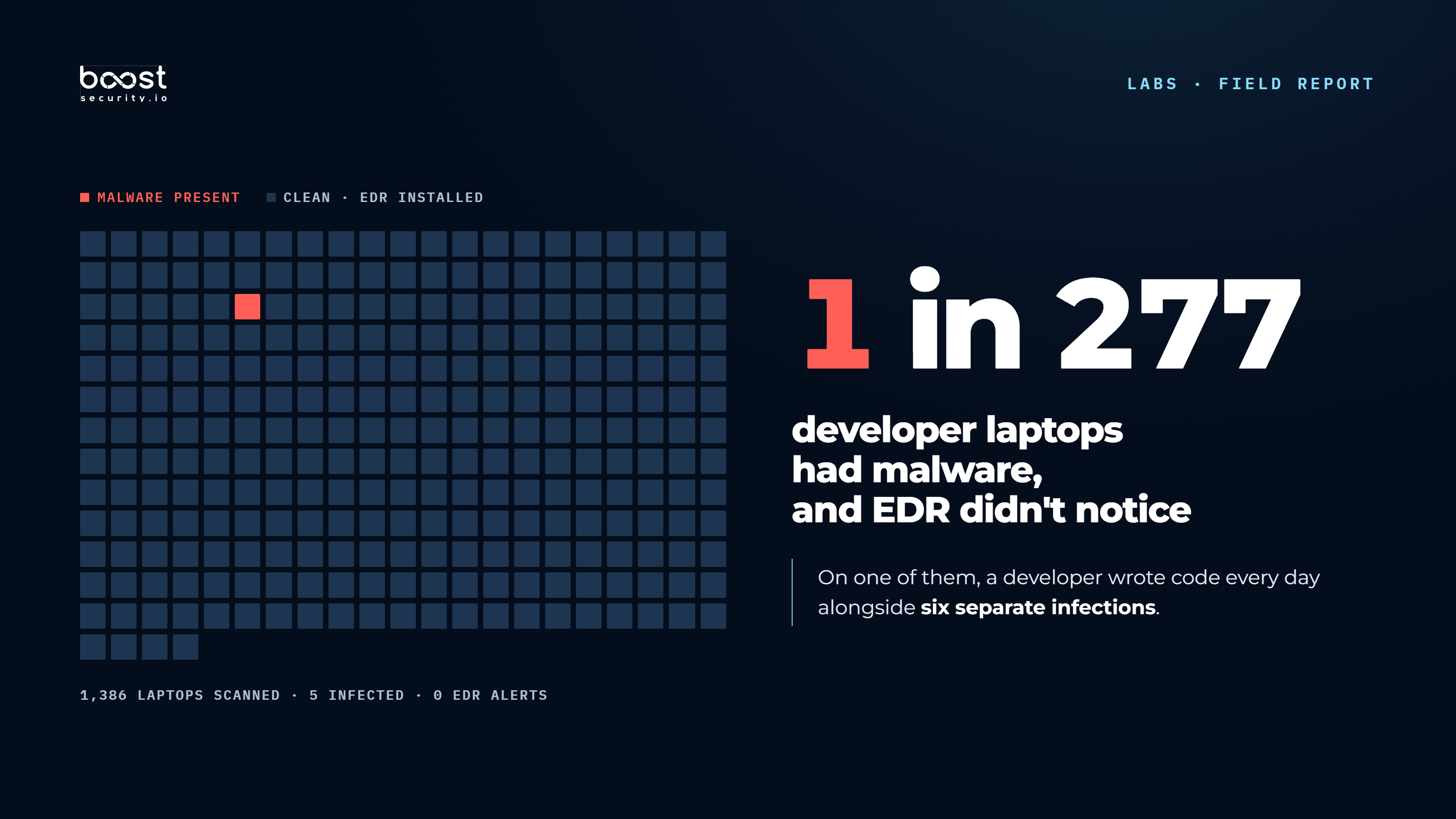
They expected our scan of 1,386 machines to turn up nothing but the test packages they'd planted themselves. What we actually found changed their assumptions about agents and their EDR’s blind spots.
Attackers Walked Malware Past EDR on Five Developer Laptops
We found active malware on five of those laptops, even though the security team had never received an EDR alert about any of them. On one of them, a developer wrote code every day alongside six separate infections.
We’re not including the devs running deliberately infected test machines. Each of these five represented a genuine, unknown and unintended deployment of malicious software. The attackers hid their malware in package dependencies, so every developer who installed a poisoned package ran the attacker's code with their own permissions.
Attackers favor that route because EDR vendors tune their products to flag unusual behavior, while a developer installing a package looks like a developer doing their job.
Attackers Who Control One Dev Machine Can Reach Production
Because the malware ran with each developer's permissions, the attackers could read any secret that developer had left on the laptop. Across the fleet, developers had left 41,660 secrets in plaintext, about 30 per machine.
The developers with infected laptops had left about 80 secrets each, nearly three times the fleet average, so the attackers on those five machines could read:
- an engineer's HashiCorp Vault login, with every runtime secret behind it
- an engineer's AWS infrastructure keys
- an OpenAI API key that bills to the company
Whoever finds one of the two Anthropic admin keys developers left in plaintext can add and remove people in the company's Anthropic organization and shut off its API keys.
Since under 3% of those secrets would ever expire on their own, an attacker keeps using every key they copied until someone rotates it, even after your team wipes the laptop.
Coding Agents Install Code With Your Developers' Permissions
Every developer we know runs a coding agent now, even though most of them half-know it does insecure things. Because the agent installs packages with the developer's own access, an attacker who gets one poisoned package past it can read every secret on that laptop.
In September 2025, the Shai-Hulud attackers harvested credentials from developer environments and used them to log in to npm as those developers and publish poisoned versions of their packages, according to CISA. Each developer who installed one of those versions gave the attackers fresh credentials to publish with, which is how the worm kept spreading.
Since EDR vendors never designed their products to check what an agent installs, a coding agent can hand its developer's keys to the next Shai-Hulud without anyone on the security team getting an alert.
Find Out What's on Your Laptop Before an Attacker Does
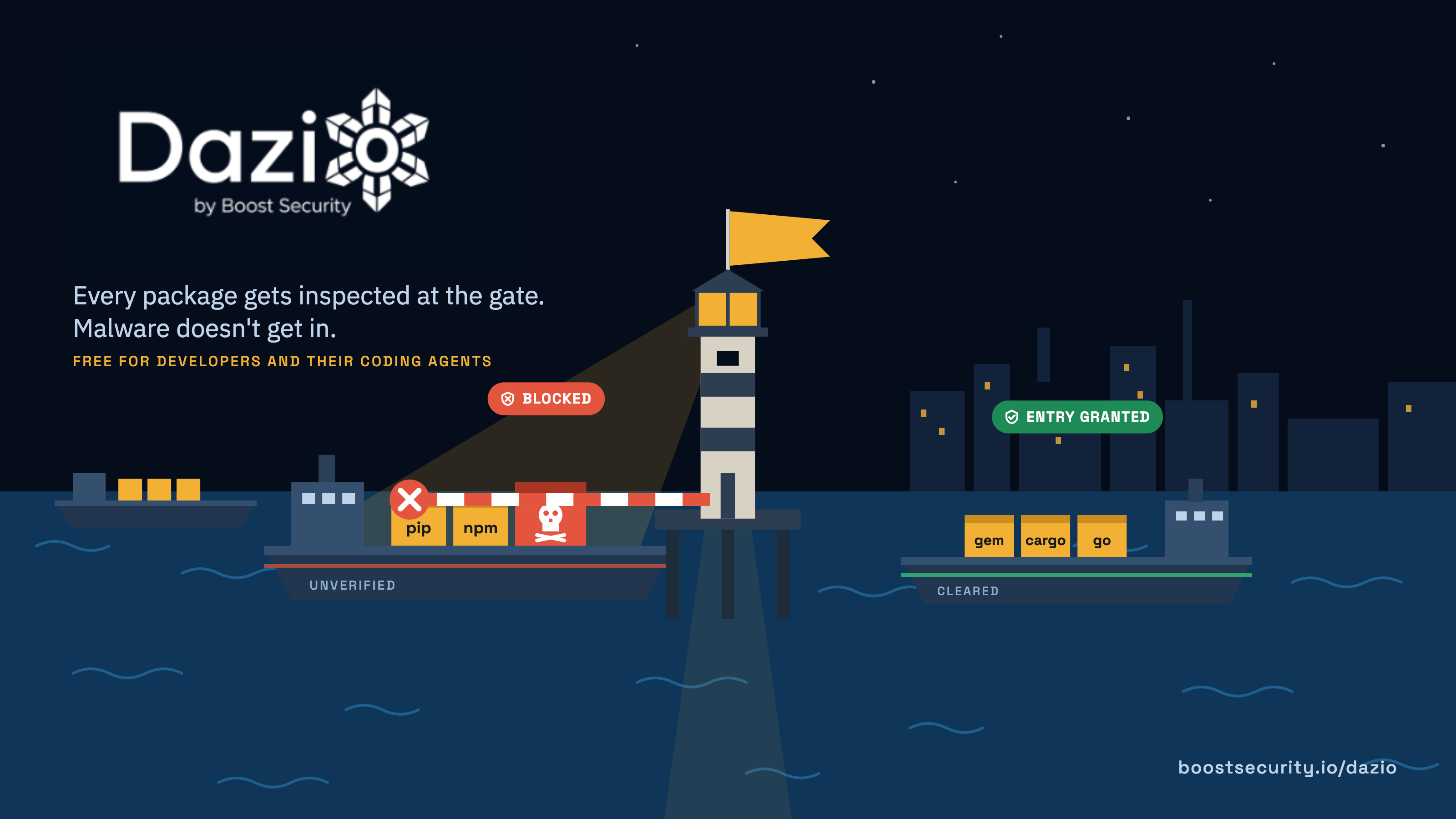
After we saw what Developer Endpoint Protection found on those 1,386 laptops, we built a free version for our friends and family, then opened it to everyone. We named it Dazio.
Dazio starts by telling you, in about two minutes, whether your laptop already has malware and where you've left secrets, down to the file and line, so you can rotate them. From then on, it checks each package before it runs, whether you typed the install command or your agent did.
Read the field report for every number from this scan, then run Dazio to see what's on your own laptop.
.svg)